Jamaat time: how to never
miss namaz in 2026
Most prayer apps get one thing wrong. They show you when the sun moves, not when your masjid actually prays. That gap is the whole problem. The real jamaat time at your local mosque can sit ten, fifteen, even twenty minutes away from the calculated time printed in an app. So you show up. And the rows are already folding back up. This guide fixes that. You'll learn what jamaat time really means, why it drifts from the calculated time, how to find the correct jamaat time near you, and how to stop missing the congregation. I built Get Iqamah after missing one too many jamaats in Bhopal. So this comes from doing it, not guessing.
What jamaat time actually means
Jamaat time is the exact minute your mosque prays together in congregation. Not the azaan. Not the calculated clock time. It's the moment the imam says "Allahu Akbar" and the rows stand behind him. That's the one you care about if you want to pray with the group.
The word jamaat means gathering. In a mosque, it's the congregation. Praying in jamaat carries far more reward than praying alone, which is why so many people plan their whole day around it. The call to line up and start is the iqamah. So when someone asks for the iqamah time, they're asking for the same thing. The jamaat time.
Here's the part people miss. Every mosque sets its own jamaat time. A committee picks it. They take the earliest valid moment for each prayer, then add a buffer so people can reach the masjid, make wudu, and settle in. That buffer is a human choice. It isn't math. One masjid might pray Fajr twenty minutes after the azaan. The masjid two streets over might wait forty.
Congregational prayer sits at the center of daily Muslim life, and each of the five prayers has its own window. If you want the religious background on the prayers themselves, the overview of salah on Wikipedia lays it out well. But that background won't tell you when your masjid prays. Only the masjid knows that.
This is why a printed clock time and a real jamaat are two different things. The clock time tells you when a prayer becomes valid. The jamaat tells you when your neighbors will actually be standing in rows. You want the second one. An app that only gives you the first is sending you to an empty hall, or worse, making you late.
So the simple definition holds. Jamaat time is a decision made by humans at your mosque, for your mosque. Get that number, and you're set. Miss it, and the math on your phone won't save you.
Jamaat time vs namaz time: the gap most apps miss
The difference between jamaat time and the namaz time in your app is the single most useful thing to understand here. Namaz time, the one apps calculate, is astronomical. It's based on the sun's angle, your latitude, and a calculation method. It tells you the earliest minute a prayer is allowed. It does not tell you when anyone gathers.
A specific finding from building this: across the 142 masjids I've logged in Bhopal, not one prayed Fajr at its app-calculated azaan time. Every Maghrib jamaat landed within about 3 to 7 minutes of sunset, while most Fajr jamaats ran 20 minutes or more after the calculated azaan. The gap is the rule, not the exception.
Jamaat time is set by people. It's the calculated time plus a buffer the committee decides on. Sometimes that buffer follows a local tradition that's older than any app. The two numbers almost never match. And the gap is not random. Fajr usually has the biggest gap because committees give people time to wake and reach the masjid. Maghrib has the smallest, often just three to five minutes, because its window is short. Here's how that tends to look in practice:
| Prayer | What the app shows | Typical gap to jamaat | Why |
|---|---|---|---|
| Fajr | Start of dawn (subh sadiq) | 20 to 45 minutes | Time to wake and reach the masjid |
| Zuhr | Sun past its peak | 15 to 40 minutes | Fits work and lunch breaks |
| Asr | Shadow length method | 10 to 30 minutes | Daylight buffer, school timings |
| Maghrib | Sunset | 3 to 7 minutes | Short window after sunset |
| Isha | Twilight ends | 15 to 45 minutes | Lets people finish dinner and arrive |
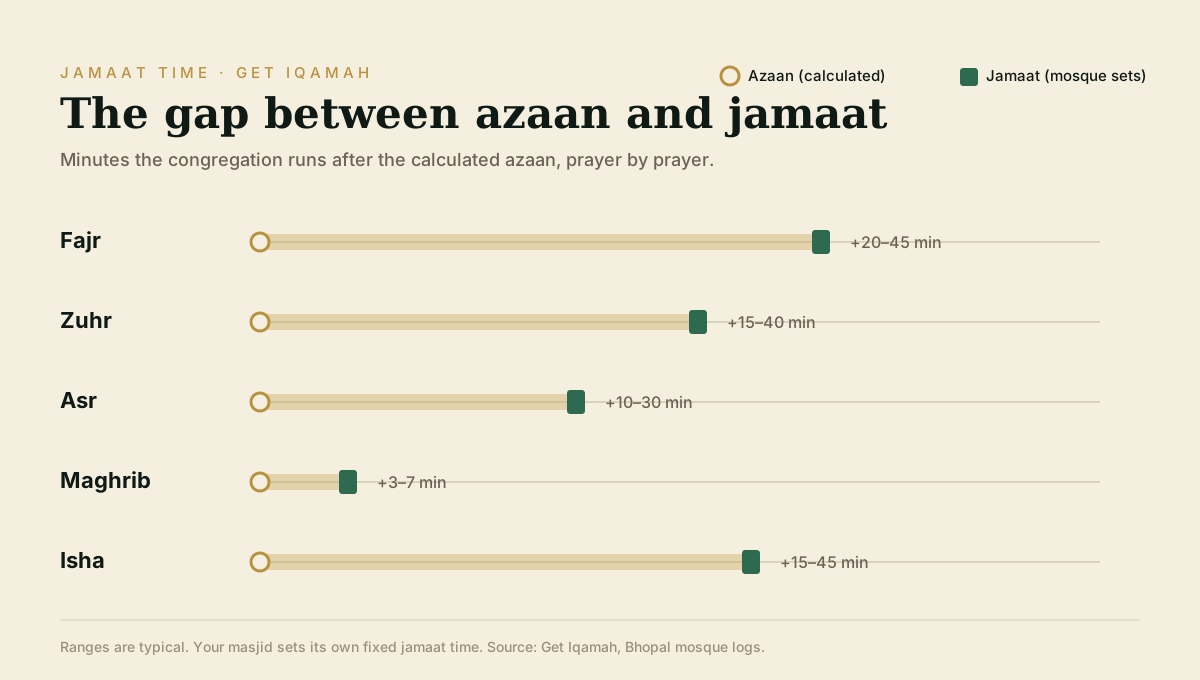
Those ranges are general. Your masjid will have its own fixed numbers. But the shape holds everywhere I've checked. The point is plain. If you treat the app's namaz time as your jamaat time, you'll be early for Maghrib and very late for Fajr.
There's also a calculation problem under the hood. Apps use different methods, like the University of Islamic Sciences Karachi or the Muslim World League. Pick a different method and your namaz time shifts by minutes. Your mosque, though, locked its jamaat time years ago and rarely cares which method your phone uses. So two people standing side by side, on two different apps, can see two different "correct" times. Neither matches the masjid.
How to find accurate jamaat time near you
To find an accurate jamaat time near you, use a location-based mosque directory that stores each committee's real timings, not a calculated prayer app. The old ways all fail when you're somewhere new. You walked to the masjid and read the board. You asked someone in a WhatsApp group. Or you guessed from an app and hoped.
The wall board is accurate but useless when you're across town. The WhatsApp group is fine until the timing changes and nobody updates the message. And the app guess, as we covered, isn't a jamaat time at all. So people kept arriving at the wrong minute. I did it for years.
A better way is a directory that stores the committee's actual numbers, mosque by mosque, and keeps them current. That's the gap Get Iqamah fills. You open it, share your location, and it lists masjids around you with their real jamaat time for each prayer, sorted by which one is coming up next. No method picker. No sun math. Just the minute the rows form.
If you only want the calculated azaan estimate for personal use, a tool like IslamicFinder does that job and has for years. It's solid for the astronomical part. Pair it with a jamaat directory and you cover both halves: when the prayer starts, and when your masjid gathers.
When you're judging any source for jamaat time, ask three questions. Who set this number? When was it last checked? Can the mosque itself correct it? If the answer to the first is "an algorithm," you're looking at a calculated time, not a jamaat. If nobody can tell you when it was last verified, treat it as stale. Timings drift, and a number from last winter may be wrong today.
This is also why crowd-sourcing with verification beats a static list. A single person can enter a masjid's jamaat time. The mosque committee, or regular attendees, then confirm or fix it. That loop keeps the data honest. A printed PDF from two years ago can't do that. It just sits there being wrong with confidence.
Why jamaat time changes through the year
A jamaat time is not fixed forever, and that trips up a lot of people. Mosques adjust their timings across the seasons, around Ramadan, and sometimes just because the committee decided to. So the number you memorized in January can be plain wrong by June.
The biggest driver is the sun. Fajr and Isha move the most because dawn and dusk shift hard between summer and winter. In a Bhopal summer, Fajr jamaat might land before 5 AM. In winter, it slides toward 6. A masjid that prays Fajr at a single fixed clock time all year is rare. Most follow the season, so their jamaat time slides with it.
Maghrib is the clearest case. Its jamaat tracks sunset almost exactly, with only a few minutes added. Sunset changes every single day. So a masjid that prays Maghrib five minutes after sunset technically changes its timing daily, even if nobody announces it. You can read more about how the prayers map to the sun's position in this entry on salat at Britannica. The mosque just adds its small human buffer on top.
Ramadan flips a lot of timings too. Isha jamaat often shifts to make room for Taraweeh. Some masjids hold a slightly later Fajr because people are up late. After Eid, things snap back. If you're relying on a number from before Ramadan, expect it to be off for that whole month and the days around it.
Then there are one-off changes. A new imam. A renovation. A committee vote to move Zuhr ten minutes to fit a nearby school's break. None of these show up in any calculated app. They live only in the masjid and in whatever directory bothered to record them. This is exactly why a jamaat time needs a "last verified" date attached. Without it, you can't tell fresh from stale.
The takeaway is simple. Treat jamaat time as a living number, not a fact carved in stone. Check it again when the season turns, when Ramadan nears, and whenever you've been away from a masjid for a while. A quick check beats walking in mid-ruku.
Juma jamaat time and the khutba
Juma jamaat time works differently from the daily five, and getting it wrong is more painful. Friday prayer has two parts: the khutba, which is the sermon, and the salah that follows. The khutba comes first, and if you arrive after it starts, many scholars say you've missed part of what makes Juma valid. So for Friday, the time you really need is when the khutba begins, not just when the salah starts.
Most apps don't show this at all. They might give you a Zuhr time and nothing else. But Juma replaces Zuhr on Friday, and the jamaat time for it is set entirely by the masjid. The committee picks a khutba start, then the salah follows a short while later. You want both numbers.
| Event | What happens | When to be there |
|---|---|---|
| First azaan | Call to prepare, people gather | Ideal arrival |
| Khutba start | Imam climbs the minbar, sermon begins | Latest safe arrival |
| Khutba end | Second part finishes | Already seated |
| Jamaat (salah) | Two rakat in congregation | In your row |
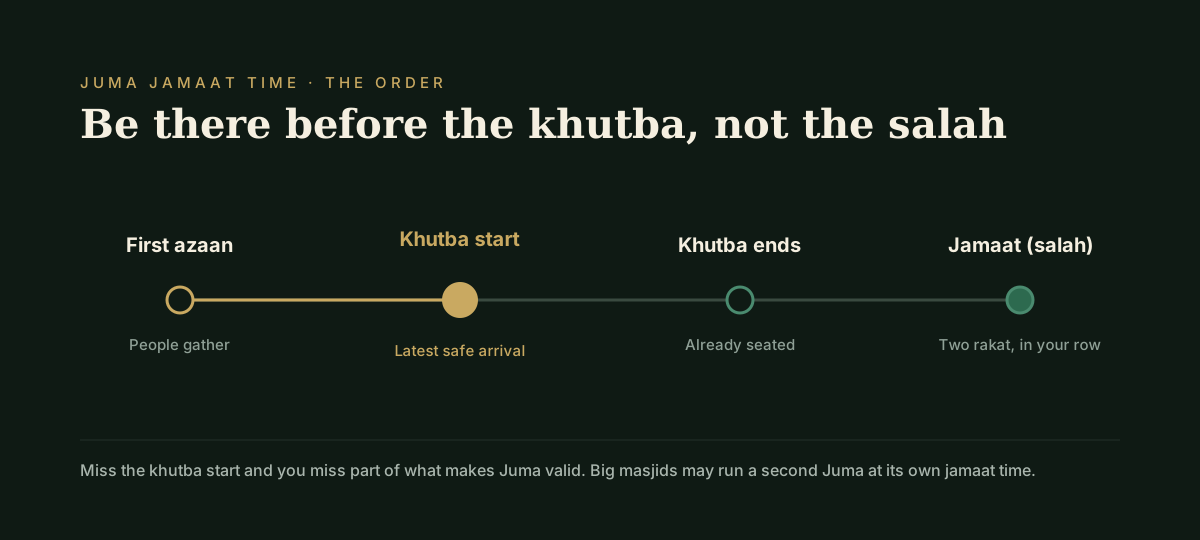
Big masjids add another wrinkle: a second Juma. When one hall can't hold everyone, some mosques run two separate Friday congregations at different times. Each has its own khutba start and its own jamaat time. If you only know one, you might miss both. This is common in dense old-city areas where a single famous masjid draws huge crowds.
In Bhopal, a place like Taj-ul-Masajid fills its front rows twenty minutes before the khutba in summer. Knowing the khutba time, not just a generic Zuhr estimate, is the difference between a good spot and standing in the courtyard. So for Friday, always look for a source that lists the khutba start, the salah jamaat time, and whether a second Juma exists.
Seven ways to never miss a jamaat time
The reliable way to never miss a jamaat time is to set alarms for the jamaat itself, minus your travel time, not for the azaan. That one habit fixes most of it. Here are seven that work, learned the hard way by being late.
1. Save your home masjid's full schedule
Write down all five jamaat times plus Juma. Don't rely on memory for the ones you pray less often, like Asr on a workday. A saved schedule means you glance, you go.
2. Set alarms for the jamaat, not the azaan
Most people set reminders for the calculated time. Set them for the jamaat instead, minus your travel time. If Isha jamaat is 8:15 and you're ten minutes away, the alarm rings at 8:00. Simple.
3. Check again when the season turns
As we covered, timings slide with the sun. Re-check your masjid's numbers at the start of summer and winter. Two checks a year keeps you accurate for Fajr and Isha especially.
4. Have a backup masjid
Know one more mosque nearby with a slightly later jamaat. Miss the first, catch the second. In a dense area you can often find a congregation forming within the next fifteen minutes if you know where to look.
5. Use a directory when you travel
In a new city, don't guess. Open a tool that shows the real jamaat time for masjids around your location, sorted by what's next. This is the single biggest time-saver when you're away from home.
6. Arrive before the iqamah, not at it
The jamaat time is when it starts, not when you should walk in. Aim to be in the row a few minutes early. You get the first row, and you're not the person rushing through the door mid-takbir.
7. Report changes you notice
If your masjid moves its jamaat time and the directory you use is wrong, fix it. Crowd-checked data only stays accurate because people correct it. Be one of those people. The next traveler will thank you.
How Get Iqamah keeps jamaat time accurate
Get Iqamah exists for one reason: to give you the real jamaat time for masjids near you, kept fresh by the people who actually pray there. I started it after mapping mosques across my own city and realizing no app held the data that mattered. Based on logging timings for 142 masjids across Bhopal, I can tell you the calculated numbers were off for almost all of them.
The model is straightforward. Each masjid's committee, or a regular attendee, enters the actual jamaat time for every prayer, plus the Juma khutba and salah times. We store the source and the date. When someone notices a change, they can suggest a correction, and verified mosques carry a badge so you know the number came from the committee itself.
That's the difference from a calculated app. We don't compute your jamaat. We record what your masjid decided. You share your location, and the app lists nearby mosques sorted by the next jamaat coming up, so the most useful one sits right at the top. You can see today's full schedule, the imam, the Juma khutba time, and whether a second Friday congregation runs.
The product is free, and it will stay free. No ads, ever. The promise is simple because the job is sacred. A tool that helps people reach prayer shouldn't be cluttered with banners or selling your data. I'd rather it be small and honest than big and noisy. We started in Bhopal because that's home, and because depth beats spread. As communities add their own mosques and committees verify them, the map grows the right way, one accurate jamaat time at a time.
Jamaat time FAQ
What is the difference between jamaat time and azaan time?
Azaan time is the call to prayer, usually tied to the calculated start of the prayer window. Jamaat time is later, when the congregation actually stands together behind the imam. The gap between them is a buffer the mosque committee sets so people can arrive and make wudu. For Fajr it can be 20 to 45 minutes. For Maghrib it's often just a few. Always pray with the jamaat time if you want the congregation.
Why does my prayer app show a different time than my mosque?
Your app shows a calculated, astronomical time based on the sun and a calculation method. Your mosque sets its own jamaat time by adding a human buffer to that figure. The two rarely match, and the difference isn't a bug. Apps also use different methods, so even two apps can disagree. The mosque's jamaat time is the real one for praying in congregation. Trust the masjid, not the math, for the actual gathering.
How do I find the jamaat time near me when I'm traveling?
Use a mosque directory that stores real committee timings and sorts masjids by your location, like Get Iqamah. Share your location and it shows the next jamaat time coming up at nearby mosques. Avoid relying only on a calculated prayer app, since that gives you the azaan estimate, not the congregation. If no directory covers the area, ask at the nearest masjid or check a local WhatsApp group for the current schedule.
Does jamaat time change in Ramadan?
Yes, jamaat time often shifts during Ramadan. Isha commonly moves to make room for Taraweeh prayers, and some masjids adjust Fajr because people stay up late. After Eid, timings usually return to normal. A number you saved before Ramadan will likely be wrong for the whole month. Re-check your masjid schedule when Ramadan starts and again right after Eid so you stay accurate through the change.
What time should I arrive for Juma jamaat?
Arrive before the khutba starts, not at the salah jamaat time. The Friday sermon is part of what makes Juma valid, and arriving after it begins means missing part of the prayer. Look for the khutba start time, which the masjid sets, and aim to be seated a few minutes before it. At busy mosques, get there 15 to 20 minutes early for a front row, since these fill up fast, especially in summer.
Is jamaat time the same as iqamah time?
Yes, jamaat time and iqamah time mean the same thing in everyday use. The iqamah is the short call given right before the congregation stands, so the iqamah time is effectively the start of the jamaat. When people search for iqamah time near me, they want the minute their mosque prays together. That is the same number as the jamaat time you would ask the committee for. The terms are interchangeable for most worshippers.
Why is the Fajr jamaat so much later than the azaan?
The Fajr jamaat time has the largest gap from the azaan because committees give people time to wake, get ready, and reach the masjid in the dark. A gap of 20 to 45 minutes is normal. The prayer window opens at dawn, but few people can be in the rows the instant the azaan sounds. So the buffer for Fajr is the most generous of any prayer. Always check the specific jamaat time for your mosque.
Can mosque timings be wrong on apps and directories?
Yes, any stored jamaat time can go stale, which is why a verification date matters. Timings drift with seasons, Ramadan, and committee decisions. A good directory shows when a number was last checked and lets the mosque or community correct it. A static PDF or an old WhatsApp message has no way to update. When you spot a wrong jamaat time, report it so the source stays accurate for the next person who relies on it.
The bottom line
Here's what to remember. Jamaat time is when your masjid actually prays in congregation, and it's set by people, not by the sun. The calculated time in a prayer app is only the azaan estimate. It tells you when a prayer becomes valid, not when your neighbors gather. The gap between the two is real, it's different for every prayer, and it shifts through the year. Fajr runs the latest after the azaan. Maghrib runs the tightest. Juma needs the khutba time most of all. To stay accurate, save your masjid's full schedule, set alarms for the jamaat and not the azaan, re-check when the season turns, and use a location-based directory when you travel. That last habit alone will save you from arriving at an empty hall in a city you don't know. If you want the real jamaat time for masjids near you, kept fresh by the people who pray there, that's exactly why Get Iqamah exists.